
Arranging bus rental in China involves more than matching the number of passengers to a vehicle. City access, luggage capacity, pickup points, route length and the group’s schedule can all affect the right choice.
A 16-seater may suit an airport transfer in Shanghai, while a larger coach can be more practical for a conference group, educational tour or multi-day itinerary.
This guide explains the main vehicle sizes, popular routes, pricing factors and booking details to consider before requesting a quote.
Key takeaway: Choose a bus based on the number of passengers, luggage volume, route and daily schedule. For an accurate quote, provide your dates, pickup points, planned stops, group size and vehicle requirements at the start.
When does private bus rental make sense in China?
Private bus rental can simplify transport when a group needs to travel together and follow a fixed schedule. Instead of arranging several taxis or asking every passenger to manage an unfamiliar route, one vehicle provides a shared pickup point, planned stops and coordinated arrival.
Bus rental in China is commonly used for:
- Airport transfers for corporate and leisure groups
- Conferences, exhibitions and business visits
- School, university and educational tours
- Sightseeing trips and private group holidays
- Weddings, celebrations and guest transfers
- Factory visits and professional delegations
- Hotel, venue and railway station transfers
The best arrangement depends on the itinerary. For travel within one city or between nearby destinations, a private bus can cover the entire journey.
For longer distances across China, it may be more efficient to combine rail or air travel with local coach transfers at each destination.
Fleet options for bus rental in China
Vehicle capacity is only the first consideration. Two groups with the same number of passengers may need different buses if one has large suitcases, exhibition materials or additional equipment.
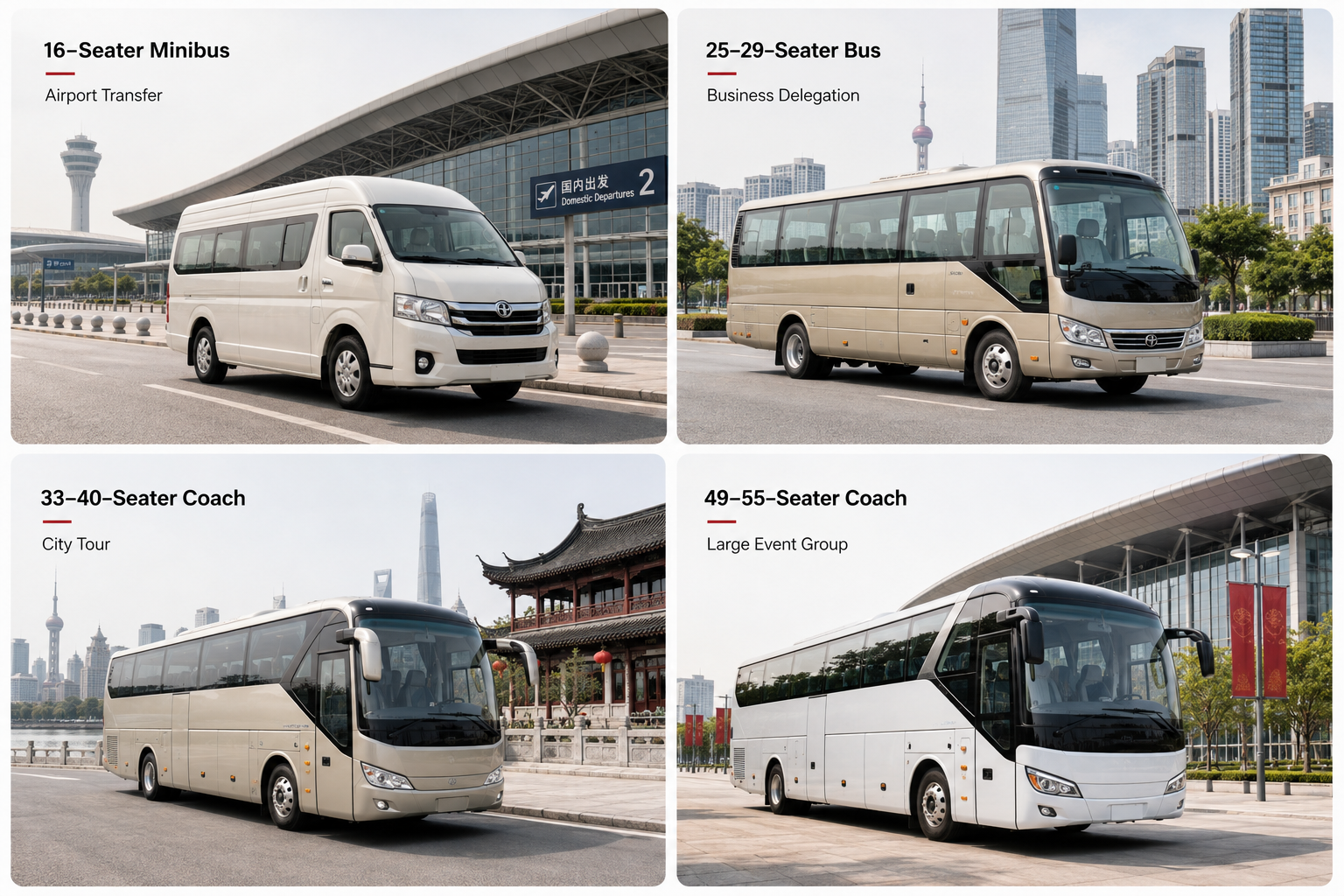
Vehicle size | Best suited for | Points to check |
16-seater minibus | Airport transfers, executive teams and small private groups | Confirm luggage space if every passenger has a large suitcase |
25 to 29-seater bus | Medium tour groups, business visits and day trips | Check whether separate luggage storage is required |
33 to 40-seater coach | Conferences, student groups and regional tours | Review comfort requirements for longer journeys |
49 to 55-seater coach | Large events, group tours and high-volume transfers | Confirm pickup access, parking and the final passenger count |
The exact vehicle model and seating configuration may vary depending on the location and availability.
Some vehicles may offer air conditioning, reclining seats, onboard entertainment, Wi-Fi or additional luggage storage. If an amenity is essential, include it in your initial enquiry instead of assuming it is standard across every vehicle.
You can review the broader Global Bus Hire fleet and use this guide to choosing the right bus size before requesting a vehicle.
Choosing the right bus size
The smallest available vehicle is not always the best option. A bus that technically has enough seats may still be unsuitable if the group is travelling with large suitcases, trade-show materials, mobility equipment or other items.
Consider these points when selecting a bus:
Passenger count
Confirm the final number of adults, children, tour coordinators and support staff. Allow some flexibility if the passenger list has not been finalised.
Luggage volume
Airport transfers and multi-day tours usually require more storage than city sightseeing trips. Ask whether the vehicle has a separate luggage compartment.
Journey duration
Comfort becomes more important on longer journeys. Seat type, legroom and onboard facilities should be considered when passengers will spend several hours on the road.
Pickup access
Large coaches may not be able to enter every narrow street, hotel driveway or central pickup area. The route and boarding location should be checked before confirming the vehicle.
Group requirements
Mention accessibility needs, child seating requirements and any essential amenities during the initial enquiry. Availability can vary by vehicle and city.
Popular bus rental routes in China
China’s major cities support different types of group travel. The route should be planned around realistic journey times, approved stopping points, parking access and the number of passenger movements during the day.
Beijing airport, city and Great Wall transfers
Groups visiting Beijing often need transport between the airport, hotel, conference venues and major attractions.
A private vehicle is particularly useful when the itinerary includes an excursion outside central Beijing, such as a visit to the Mutianyu section of the Great Wall. The group can travel together without coordinating multiple vehicles or separate pickup times.
Shanghai airport and business district transfers
Shanghai itineraries commonly connect Pudong International Airport or Hongqiao International Airport with hotels, exhibition venues, offices and visitor areas such as the Bund.
A single coach can keep a business delegation, conference group or tour party together across several scheduled stops.
Guangzhou and Shenzhen business routes
The Guangzhou-Shenzhen corridor is relevant for trade events, factory visits and corporate programmes.
The final itinerary should account for the number of sites, the time required at each stop and whether the vehicle will remain with the group throughout the day.
Xi’an city tours
Xi’an group transport may combine airport or railway station pickup with hotel transfers and visits to major cultural sites.
A private bus gives the organiser more control over departure times, planned stops and passenger coordination.
Chengdu and regional excursions
Chengdu can serve as a base for city travel, business visits and regional sightseeing. Journey duration and driver scheduling become especially important when the plan includes several destinations in one day.
Multi-city tours
A multi-city programme may include Beijing, Xi’an, Shanghai, Chengdu or other regional centres.
For very long distances, using high-speed rail or domestic flights between cities and arranging local buses at each stop may reduce road travel time. A transport planner can compare a through-coach itinerary with a city-by-city transport solution.
Bus rental China pricing and quote factors
There is no single fixed price for every bus rental in China. Quotes are normally based on the complete operating plan rather than seating capacity alone.
The main pricing factors include:
- Vehicle size and class
- Rental date and total duration
- Pickup and drop-off locations
- Total distance and route complexity
- Number of operating hours required each day
- Driver time and overnight requirements
- Parking, tolls and access charges
- Airport, railway station or venue waiting time
- Luggage and equipment requirements
- Requested onboard amenities
- Peak-season and event-date availability
A smaller vehicle does not always produce the lowest practical cost. If it cannot accommodate the group’s luggage or requires a second vehicle, a larger coach may be the more efficient option.
What should a bus rental quote include?
Before confirming a booking, review what is included in the quote. A clear quote should identify the selected vehicle, itinerary, operating period and relevant charges.
Information | Why it matters |
Travel dates and times | Confirms vehicle availability and operating hours |
Passenger count | Determines the minimum seating capacity |
Luggage quantity | Helps identify the required storage space |
Pickup and drop-off points | Allows accurate route planning |
All planned stops | Affects distance, time and access requirements |
Vehicle preference | Helps match comfort and service expectations |
Required amenities | Confirms what must be included in the vehicle |
Group type | Supports planning for corporate, student, event or leisure travel |
Ask whether parking, tolls, waiting time, driver accommodation and additional hours are included or charged separately.
For international group travel, use this 12-point international bus rental checklist to prepare the booking details before requesting a quote.
How to book a bus in China
1. Finalise the passenger and luggage count
Confirm how many people will travel and how much luggage they will carry. Allow some additional capacity if the passenger list has not been finalised.
Do not select a vehicle using the passenger count alone.
2. Build a complete itinerary
List each airport, railway station, hotel, venue and attraction in travel order. Include the preferred pickup time and how long the group expects to remain at every stop.
3. State the essential requirements
Mention accessibility needs, child seating requirements, luggage volume and essential onboard amenities. These requirements should be confirmed before the booking is finalised.
4. Review the complete quote
Check the vehicle capacity, operating hours, route, driver arrangements, parking, tolls, waiting time and booking-change terms.
Ask for clarification before confirming the booking if any item is unclear.
5. Reconfirm the schedule
Share the final passenger details, pickup instructions and the organiser’s contact information.
For airport or railway station pickups, provide the correct arrival details and communicate any schedule changes promptly.
How far in advance should you book?
Booking two to four weeks in advance is a useful general guideline for standard group transport. More notice may be required for large groups, major events, public holidays and multi-day journeys.
Early booking provides more time to:
- Secure the required vehicle size
- Confirm luggage capacity
- Review pickup access
- Coordinate several stops
- Check requested amenities
- Finalise the quote and payment
- Communicate the schedule to passengers
Last-minute bookings may still be possible, but vehicle choice can be more limited.
Plan group transportation in China with Global Bus Hire
Global Bus Hire supports airport transfers, city tours, corporate travel, event transportation and private group journeys.
The booking process starts with your destination, group size, dates and special requirements. The team can then recommend a suitable vehicle and prepare an itinerary-based quote.
Explore private charter bus rental options in China or review the available group transportation services for different types of journeys.
Ready to plan your group transport? Contact Global Bus Hire with your travel dates, route, passenger count and vehicle requirements.
Frequently Asked Questions
How much does bus rental in China cost?
Bus rental pricing depends on the vehicle size, travel dates, journey duration, distance, route, waiting time, parking, tolls and requested amenities. A complete itinerary is required to prepare an accurate quote.
What bus sizes are available for groups in China?
Common options range from 16-seater minibuses to larger 49 to 55-seater coaches. The exact vehicle model and capacity depend on the city, travel date and availability.
Can I rent a bus with a driver in China?
Yes. Private group bus rentals are arranged with a professional driver. Include every planned stop and the expected daily schedule in your enquiry so the required operating time can be calculated.
Is a private bus suitable for airport transfers in China?
Yes. A minibus or coach can transport a group from the airport to a hotel, venue or another planned stop. Provide the flight details, passenger count and luggage quantity when requesting the booking.
Can I book one bus for a multi-city tour in China?
It may be possible, but it is not always the most efficient option for long distances. Rail or air travel between cities combined with local bus rental at each destination may reduce travel time. The best arrangement depends on the route and schedule.
How far in advance should I book a bus in China?
Booking two to four weeks ahead is recommended for standard journeys. More notice is advisable for large groups, major events, holidays and multi-day itineraries.
What information is required to get a bus rental quote?
Provide the travel dates, passenger count, luggage quantity, pickup and drop-off locations, planned stops, daily timings, vehicle preference and required amenities.
