
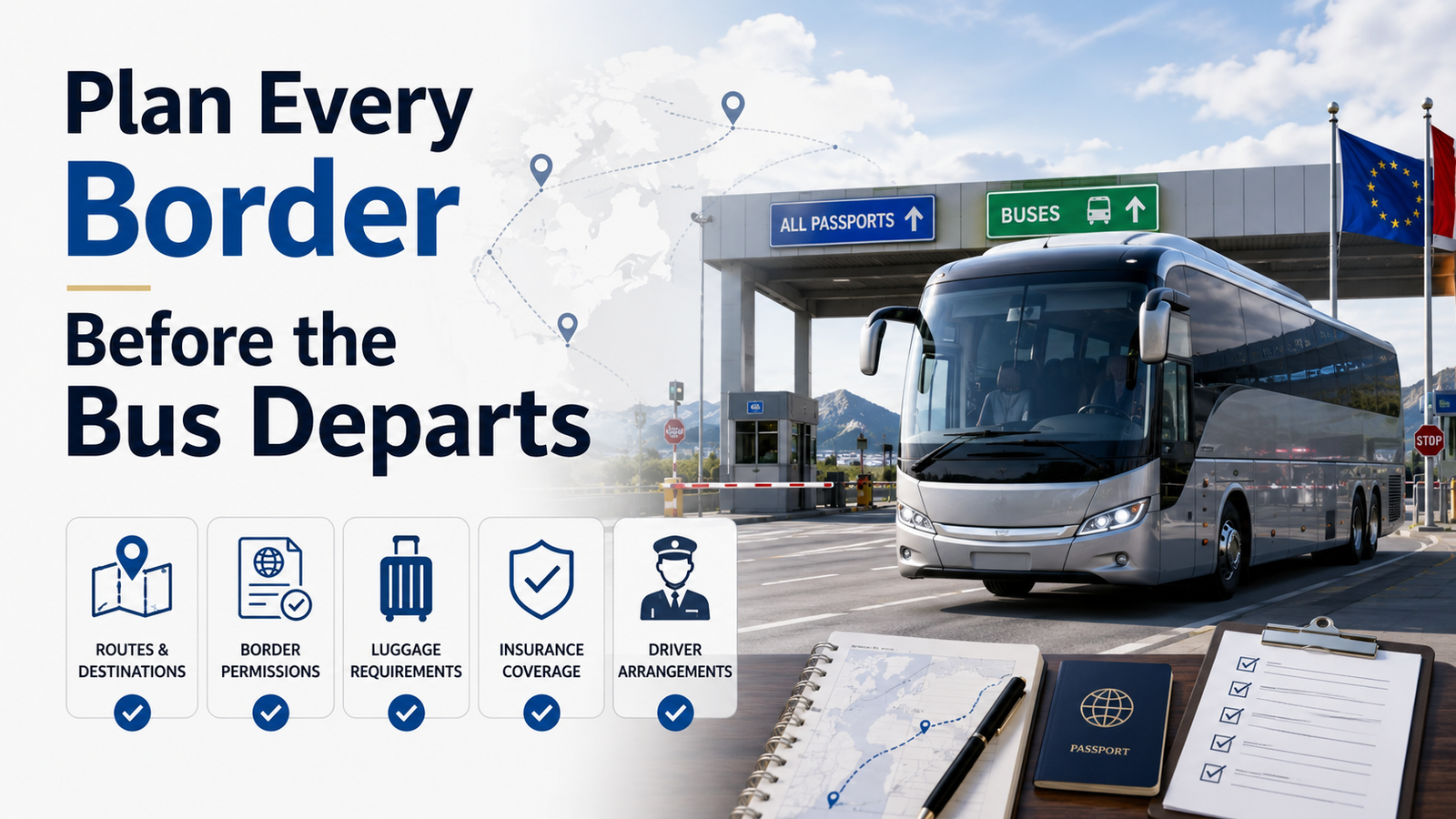
12 Things to Confirm Before Booking Across Countries
Booking group transportation within one city is usually straightforward. Planning transport across several countries involves more variables.
Border permissions, driver working limits, road charges, insurance requirements, luggage capacity, and airport pickup rules can all affect the final itinerary. Missing one detail may result in delays, vehicle changes, additional charges, or a route that cannot operate as originally planned.
An international bus rental should therefore begin with a complete itinerary and a clear understanding of what the quotation includes.
Whether you are organising a corporate tour, school trip, conference programme, sporting event, incentive journey, or multi-country holiday, these 12 checks will help you plan a more reliable booking.
International Bus Rental Checklist at a Glance
What to confirm | Why it matters | Information to provide |
Countries on the itinerary | Determines route availability and documentation | Complete country and city list |
Cross-border permissions | Confirms whether one vehicle can complete the route | Border crossings and travel dates |
Driver-hour restrictions | Affects timing and overnight stops | Daily schedule and journey duration |
Insurance documentation | Confirms suitable passenger and vehicle coverage | Group type and route |
Local transport regulations | May affect access, parking, or vehicle type | Exact venues and pickup points |
Tolls and road charges | Can change the final price | Full route and planned stops |
Driver accommodation | May be required for overnight journeys | Hotel locations and trip duration |
Airport pickup coordination | Helps prevent missed connections and delays | Flight numbers and arrival times |
Language support | Improves communication across locations | Preferred contact language |
Luggage capacity | Determines the right vehicle size | Number and type of bags |
Emergency support | Provides assistance during unexpected changes | Lead traveller contact details |
Quote inclusions | Helps prevent unexpected charges | Complete service requirements |
1. Confirm Every Country Included in the Itinerary
Start by listing every country the group will enter, even when a country is only being used for transit.
A route from Paris to Milan, for example, may involve different planning requirements from separate local transfers in France and Italy. The transport provider needs to know whether the same vehicle is expected to cross the border or whether the group can change vehicles at a planned location.
Provide:
- Every departure and arrival country
- All overnight destinations
- Transit countries
- Border crossing points, when known
- Ferry or tunnel segments
- Dates and estimated crossing times
Review the available Global Bus Hire destinations before submitting your itinerary. Destination availability does not automatically mean that every cross-border route can be completed by the same vehicle.
2. Check Cross-Border Bus Hire Permissions and Permits
Do not assume that a bus operating in one country can automatically carry passengers into another.
Cross-border permissions can depend on the countries involved, operator licences, vehicle documentation, local partnerships, and the type of journey being provided.
Ask the transport provider:
- Can the same vehicle complete the full route?
- Will the group need to change vehicles?
- Who arranges the required permits?
- Are border or permit fees included?
- How much time should be allowed for the crossing?
- Are passenger documents checked before departure?
Cross-border bus hire may be available on selected routes, so the complete itinerary should be shared before the booking is confirmed.
3. Build the Schedule Around Driver-Hour Restrictions
An itinerary that looks reasonable for passengers may not be legally or operationally possible for one driver.
Commercial drivers are subject to working, driving, break, and rest requirements. These rules vary by country and can affect departure times, sightseeing stops, overnight locations, and the number of drivers required.
A long travel day may require:
- A second driver
- A longer rest stop
- An earlier departure
- An overnight break
- A revised sightseeing schedule
- A different pickup location
Share the full daily itinerary, not only the first pickup and final destination. Include meal stops, excursions, hotel transfers, and evening transport requirements.
This allows the transport provider to assess the complete working day rather than estimating from the main driving distance alone.
4. Request International Coach Rental Insurance Documents
Insurance should be discussed before payment, especially for school groups, corporate programmes, travel agencies, and international events.
Ask what insurance applies to:
- The vehicle
- The driver
- Commercial passenger transportation
- Cross-border operation
- Third-party liability
- Passenger belongings
Your organisation may also require documents for internal risk approval, procurement, or vendor onboarding.
Do not rely only on a general statement that the vehicle is insured. Confirm whether the documentation is valid for the countries and services included in the itinerary.
5. Check Local Transport and Access Regulations
Local transport rules can affect where a coach may enter, stop, wait, or park.
Historic city centres, low-emission zones, airport terminals, exhibition venues, stadiums, and hotels may have restrictions that do not apply to smaller vehicles.
Confirm whether the route includes:
- Restricted city zones
- Coach permit areas
- Low-emission zones
- Limited-height roads
- Narrow streets
- Timed loading bays
- Pre-booked coach parking
- Venue security checks
Provide exact addresses wherever possible. A city name alone is not enough to determine whether a full-size coach can reach the requested entrance.
For complex itineraries, the right group travel transportation service should consider passenger movement, route access, parking, and local operating conditions.
6. Confirm Tolls, Road Charges, Parking, and Border Fees
International journeys may include costs beyond the vehicle and driver.
Depending on the route, additional charges may include:
- Highway tolls
- Road taxes
- Congestion charges
- Low-emission zone fees
- Border permits
- Ferry tickets
- Tunnel charges
- Airport access fees
- Coach parking
- Overnight parking
Ask whether these costs are included in the quotation, estimated separately, or charged after the journey.
A lower initial quote may not result in the lowest final price if major route expenses are excluded.
7. Arrange Driver Accommodation and Meals
Multi-day trips often require accommodation for the driver.
Some travel organisers assume that the driver will arrange and pay for their own hotel. In other cases, the organiser is expected to provide accommodation, parking, and meals.
Before confirming the booking, ask:
- Is driver accommodation included?
- Does the hotel need secure coach parking?
- Is a private room required?
- Are breakfast and evening meals included?
- Is accommodation needed for one or two drivers?
- Who pays city taxes or parking charges?
The driver’s hotel should also support the required rest period. A property located far from the group hotel may create additional driving time and complicate the next morning’s pickup.
8. Plan Airport Pickup Coordination in Detail
Airport pickups require more information than the scheduled flight arrival time.
The transport provider may need to coordinate terminal access, waiting areas, passenger collection points, airport permits, and delayed flights.
Provide:
- Airline and flight number
- Scheduled arrival time
- Arrival terminal
- Passenger count
- Number of checked bags
- Group leader’s mobile number
- Meet-and-greet requirements
- Expected immigration and baggage collection time
For groups arriving on several flights, decide whether the coach should wait for everyone or operate multiple transfers.
Also ask when waiting-time charges begin. They may start at the scheduled pickup time, the vehicle’s arrival time, or after an agreed grace period.
9. Confirm Multi-Language Communication
International group transportation may involve organisers, passengers, drivers, hotels, guides, and local suppliers who do not share the same first language.
Confirm:
- The language used by the booking team
- The driver’s expected communication level
- Whether a guide or translator is required
- How last-minute instructions will be shared
- Who will contact the driver during the journey
- Whether written pickup instructions can be provided
The driver does not always need to act as a tour guide. However, the group leader should be able to communicate essential information about timing, stops, passenger requirements, and route changes.
Written instructions can reduce misunderstandings when the itinerary covers several countries.
10. Match Luggage Capacity to the Vehicle Type
Passenger capacity and luggage capacity are not the same.
A 50-seat coach may not carry 50 passengers comfortably if everyone has a large suitcase, cabin bag, and event equipment. Available storage also varies according to the vehicle type and local fleet configuration.
Provide details about:
- Large suitcases
- Cabin bags
- Sports equipment
- Musical instruments
- Wheelchairs
- Pushchairs
- Exhibition materials
- Medical equipment
- Group supplies
Ask whether the luggage will be stored under the coach, inside the passenger area, in a trailer, or in another support vehicle.
For airport tours and multi-country journeys, choosing a slightly larger coach may be more practical than using every available seat.
11. Confirm Emergency and On-Trip Support
International group transport can be affected by delayed flights, road closures, severe weather, passenger illness, vehicle issues, or changes to the event schedule.
Ask what happens when the original itinerary changes.
Confirm:
- Whether support is available during the journey
- Which number should be used outside normal office hours
- Who contacts the group if the vehicle is delayed
- How replacement vehicles are arranged
- How route changes are approved
- Who can authorise additional costs
- Whether support is available in every country on the route
The group organiser should save the relevant support details and provide at least two traveller contact numbers.
12. Review Inclusions Before Choosing a Bus Rental Company
Do not approve an international bus rental quote based only on the total price.
The quotation should clearly explain what is included, what is estimated, and what may be charged separately.
Check whether the price includes:
- Vehicle hire
- Professional driver
- Fuel
- Driver accommodation
- Driver meals
- Tolls and road charges
- Parking
- Airport access
- Border permits
- Ferry or tunnel costs
- Additional drivers
- Waiting time
- Cleaning
- Taxes
- Gratuities
- Out-of-hours support
Also review the cancellation, payment, amendment, overtime, and refund terms.
When comparing quotes from more than one bus rental company, compare the same scope of work. One quote may appear cheaper simply because it excludes several route-related costs.
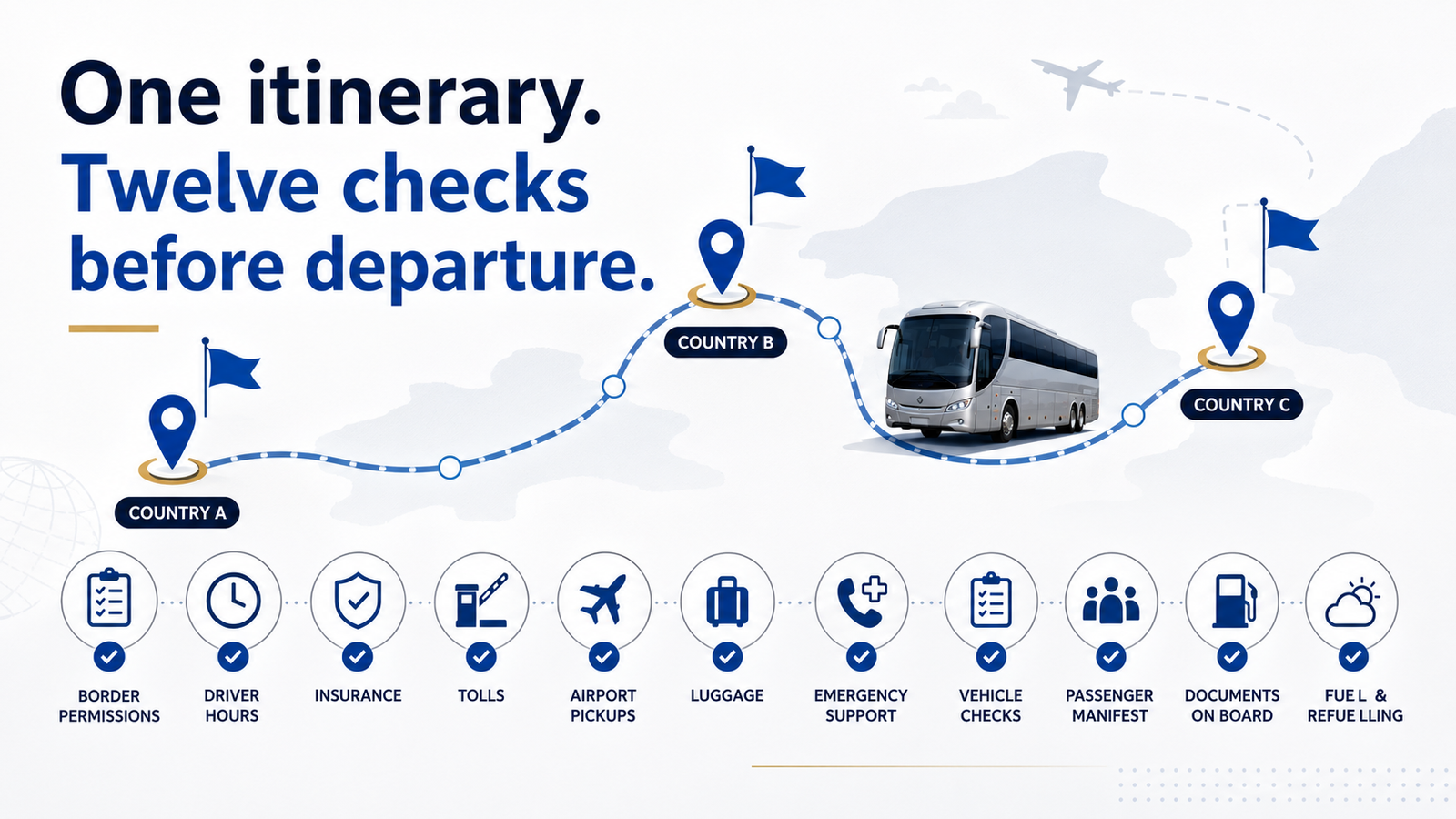
Final International Group Transport Booking Checklist
Before approving the booking, confirm that:
Route and Destinations
- Every country is listed
- Every city and overnight stop is listed
- Transit countries are included
- Exact pickup and drop-off addresses are available
- Border crossing points are identified where possible
- Ferry or tunnel travel is included
Compliance and Documentation
- Cross-border operation has been confirmed
- Permit responsibilities are clear
- Driver-hour requirements have been reviewed
- Insurance documents have been requested
- Local access restrictions have been checked
- Passenger travel document requirements have been communicated
Vehicle and Passenger Requirements
- Final passenger count is confirmed
- Luggage quantities are listed
- Accessibility requirements are included
- Equipment and oversized items are declared
- Required onboard facilities are listed
- Vehicle size suits both passengers and luggage
Driver and Operational Planning
- Driver accommodation responsibility is confirmed
- Driver meal arrangements are confirmed
- Coach parking is available at overnight hotels
- Additional driver requirements are understood
- Daily start and finish times are realistic
- Required rest stops are included
Airport and Communication Planning
- Flight numbers and terminals are provided
- Waiting-time terms are confirmed
- Meet-and-greet arrangements are clear
- The group leader’s contact number is shared
- The preferred communication language is confirmed
- Emergency contact details are saved
Pricing and Confirmation
- Fuel is included or clearly excluded
- Tolls and road charges are explained
- Border, ferry, and tunnel charges are explained
- Parking and airport fees are explained
- Taxes and gratuities are explained
- Cancellation and amendment terms are reviewed
- Vehicle allocation is confirmed
- The final itinerary has been approved in writing
Final Thoughts
Successful international group travel depends on what is confirmed before departure.
The right coach is important, but so are border permissions, driver schedules, luggage space, airport access, driver accommodation, local transport rules, and clear pricing.
Sharing a complete itinerary allows the transport provider to identify potential issues before they affect the journey.
Explore Global Bus Hire’s worldwide bus hire services and review the available destinations. Once your countries, dates, passenger count, luggage requirements, and route are ready, submit the details through the Global Bus Hire contact page to request a quote.
Frequently Asked Questions
Can one bus travel through several countries?
It may be possible on selected routes, but this depends on the countries involved, the route, operating permissions, vehicle documents, and local transport regulations. Share the complete itinerary before booking so the provider can confirm whether one vehicle can complete the journey.
How far in advance should I book an international bus rental?
Booking early gives the transport provider more time to confirm vehicles, drivers, border requirements, accommodation, and route access. Complex multi-country journeys should usually be planned earlier than local transfers.
Are border permits included in an international bus rental quote?
Not always. Ask whether permit costs and administration are included, estimated separately, or payable after the journey.
Do international coach quotes include tolls and parking?
Quote structures vary. Tolls, road charges, city access fees, airport charges, and parking may be included or billed separately. Review every inclusion and exclusion before approving the booking.
Does the organiser need to book a hotel for the driver?
For some multi-day journeys, the organiser may need to provide a suitable private room and coach parking. In other bookings, the bus rental company may include accommodation in the quote. Confirm responsibility in writing.
What happens when the route exceeds driver-hour limits?
The schedule may require a longer break, an overnight stop, a revised departure time, or an additional driver. The provider should review the full daily itinerary before confirmation.
Can the same bus collect passengers from several international airports?
This may be possible depending on airport access, flight times, journey distance, waiting limits, and driver availability. Provide every flight number, terminal, and arrival time so the schedule can be assessed properly.
What information should I send to an international bus rental company?
Provide the countries, cities, dates, exact addresses, passenger count, luggage details, flight information, daily schedule, accessibility requirements, accommodation plan, border crossings, and requested onboard facilities.
Is worldwide bus hire suitable for corporate and event travel?
Yes. Worldwide bus hire can support conferences, company tours, incentive travel, exhibitions, sporting events, educational programmes, and private groups. The itinerary should be planned around the operational requirements of each destination.
How can I compare two international bus rental quotes?
Compare the complete scope rather than the total price alone. Check the vehicle size, driver costs, fuel, tolls, permits, parking, airport fees, accommodation, waiting time, taxes, cancellation terms, and emergency support.
