
Corporate Event Transportation Checklist: 15 Steps to Complete Before Booking
Corporate event transportation problems often begin long before the vehicle arrives. Incomplete passenger numbers, unsuitable pickup locations, overlooked accessibility requirements, and unclear loading instructions can disrupt an otherwise well-planned event.
A reliable transport plan should connect flights, hotels, venues, passenger groups, vehicles, and event timings. This checklist gives event planners, HR teams, office managers, and executive assistants a practical timeline for organising corporate transportation services.
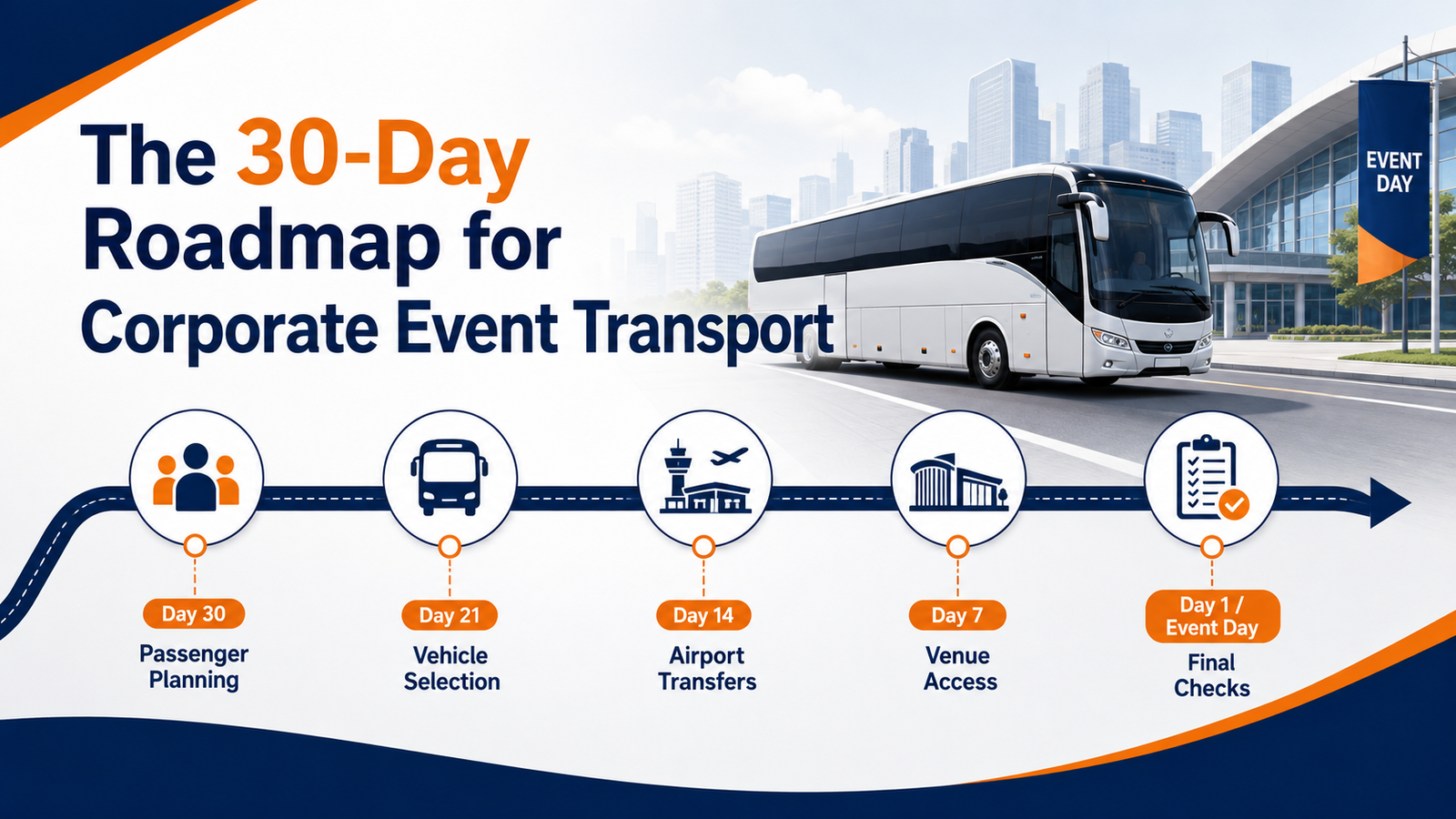
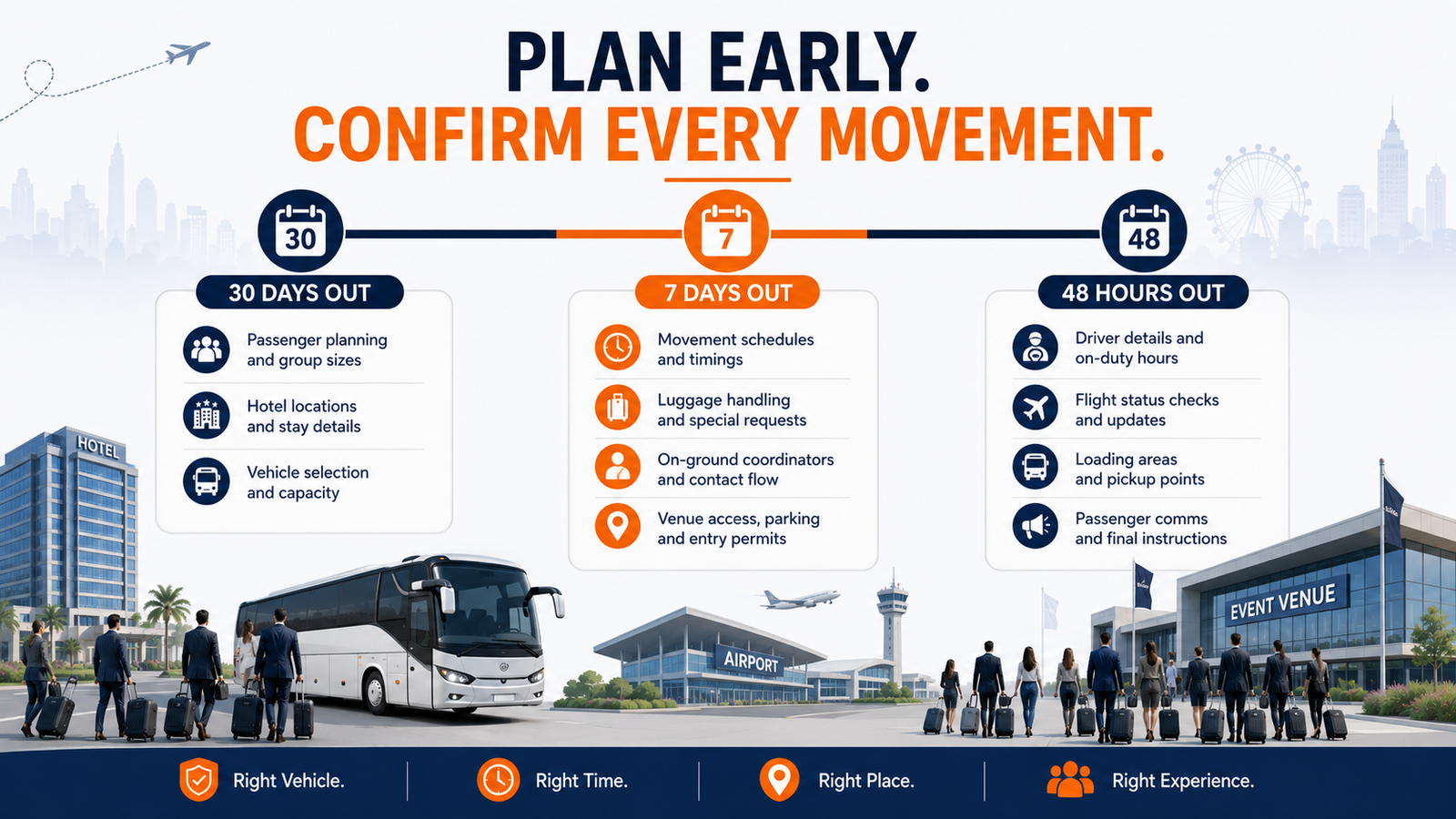
Corporate Event Transportation Timeline
Planning stage | Main objective | Key decisions |
30 days before | Build the transport plan | Passengers, venues, pickup points, accessibility, and vehicles |
Seven days before | Confirm operations | Timings, luggage, passenger lists, coordinators, and access |
24 to 48 hours before | Prepare for travel | Driver details, contacts, flights, loading areas, and instructions |
30 Days Before the Event
1. Confirm Passenger Numbers
Count passengers by individual journey rather than total event attendance. Airport transfers, hotel shuttles, evening functions, and final departures may each have different passenger numbers.
Keep a small capacity buffer for late registrations, but avoid booking every vehicle based on the highest possible estimate.
2. Finalise Venues and Hotels
Confirm the complete addresses of venues, hotels, airports, restaurants, and off-site meeting spaces. Ask which entrance coaches should use, whether access restrictions apply, and how long vehicles may wait.
These details allow the transport provider to assess each route accurately and identify access issues before the event.
3. Select Practical Pickup Locations
A convenient location for passengers may not be suitable for a coach. Choose pickup points with safe waiting areas, clear road access, and enough space for boarding.
When several hotels are involved, compare one central pickup point with separate hotel stops. A central point may reduce journey time, while individual hotel pickups may be more convenient for delegates.
4. Identify Accessibility Requirements
Ask attendees about accessibility needs early. Passengers may require step-free boarding, wheelchair space, additional boarding time, closer vehicle access, or luggage assistance.
Early notice gives the transport provider enough time to confirm a suitable vehicle and loading area.
5. Decide the Vehicle Mix for Corporate Bus Rental
Choose vehicles for each journey rather than using one vehicle size throughout the event. An executive group may require a smaller vehicle, while the main delegate transfer may need several coaches.
Review the Global Bus Hire fleet and compare vehicle capacity, luggage storage, access requirements, and journey duration.
Several timed departures may work better than one large corporate bus rental when attendees finish sessions or depart hotels at different times.
Seven Days Before the Event
6. Confirm Arrival and Departure Schedules
Compare the transport plan with the final event agenda, registration times, hotel check-in arrangements, and airport schedules.
Allow time for boarding, traffic, security checks, and walking from the drop-off point. Important groups should arrive before the programme begins rather than at the scheduled starting time.
7. Check Luggage and Equipment Requirements
Passenger numbers do not show the full storage requirement. Airport groups may carry checked luggage, while event teams may have signs, exhibition materials, presentation equipment, or branded items.
Share the expected luggage and equipment volume so the assigned vehicle can accommodate both passengers and belongings safely.
8. Prepare Lists for Your Corporate Shuttle Service
Create a separate passenger list for every pickup and departure. Include each traveller’s name, pickup point, journey time, hotel, and any essential assistance requirement.
Route-specific lists make boarding faster and reduce the risk of passengers joining the wrong corporate shuttle service.
Avoid using one master spreadsheet at every pickup point. Each coordinator should receive only the information needed for that specific journey.
9. Assign Transport Coordinators
Nominate one lead transport coordinator and, where necessary, one person at each major pickup point.
Coordinators should have the passenger list, driver contact details, schedule, and venue information. They should also know who can approve additional waiting time, an extra trip, or a route change.
Drivers should not be expected to manage attendee registration or decide whether the vehicle should wait for missing passengers.
10. Confirm Access for Group Transportation Services
Recheck coach permits, security procedures, parking arrangements, loading limits, and the exact entrance vehicles should use.
Ask whether another event will be using the same loading area. Share all confirmed access instructions with the provider managing your group transportation services.
A venue address alone may not be enough. A map pin, entrance name, or loading-zone photograph can reduce confusion on the day.
24 to 48 Hours Before the Event
11. Confirm Driver and Vehicle Details
Request the driver’s name, contact number, assigned vehicle type, registration details where available, and expected arrival time.
Check that the assigned capacity still matches the final passenger and luggage numbers. Send any venue passes or revised access instructions to the transport provider.
12. Share Emergency Contacts
Prepare a short contact sheet containing the event transport lead, venue operations contact, hotel contact, internal event manager, and transport provider’s support number.
Everyone involved should know whom to contact if there is a delay, missing passenger, access problem, or schedule change.
13. Recheck Flight Arrival Times
Review incoming flight times 24 to 48 hours before travel and again on the day of arrival. Changes can affect vehicle dispatch, waiting time, and shared airport transfers.
Confirm the correct terminals and provide passengers with a clear meeting point. For groups arriving on several flights, decide how long the vehicle should wait before departure.
14. Confirm Loading Areas
Reconfirm pickup and loading areas with every hotel and venue. Construction work, security changes, road closures, or another event may have changed the original arrangements.
Check whether passengers should wait in the lobby, at a side entrance, or at a dedicated coach bay. This prevents the vehicle and passengers from waiting in different locations.
15. Send Employee Transportation Instructions
Send passengers a short message containing the pickup location, reporting time, departure time, coordinator’s contact number, bus identification, luggage guidance, and late-arrival procedure.
Use one time zone and clearly distinguish between “arrive by” and “departure time.” For multi-day events or employee transportation services, send separate instructions for each day or route.
Final Check Before Booking
Before approving the transport plan, verify that every journey has a passenger estimate, vehicle allocation, pickup point, departure time, coordinator, and backup contact.
The quotation should also explain how waiting time, parking, airport fees, additional stops, and schedule changes will be handled.
Global Bus Hire provides corporate transportation services for meetings, conferences, employee movement, airport transfers, and other business travel requirements.
Once the route, dates, passenger numbers, luggage, and access requirements are ready, submit them through the Global Bus Hire quote and contact page to request a suitable transport plan.
Frequently Asked Questions
How far in advance should corporate event transportation be booked?
Corporate event transportation should generally be booked two to four weeks in advance. Large conferences, peak-season events, and multi-city programmes may require earlier planning.
How many vehicles does a corporate event need?
The number of vehicles depends on passenger groups, hotels, flight times, venue access, and departure patterns. One large coach may suit a single movement, while several timed shuttles may work better for staggered schedules.
What details are needed for a corporate bus rental quote?
Provide the event dates, passenger numbers, complete addresses, pickup times, luggage details, accessibility requirements, vehicle preferences, and venue restrictions.
Who should manage passenger boarding?
Assign an event transport coordinator rather than leaving passenger management to the driver. The coordinator should hold the correct passenger list and manage any approved changes.
Should flight delays be included in the transport plan?
Yes. Confirm how delays, terminal changes, waiting time, and missed connections will be handled. Share the flight details and provide a reachable airport coordinator.
What should passengers receive before departure?
Passengers should receive the exact pickup point, reporting time, departure time, coordinator contact details, vehicle identification, luggage guidance, and late-arrival procedure.
