
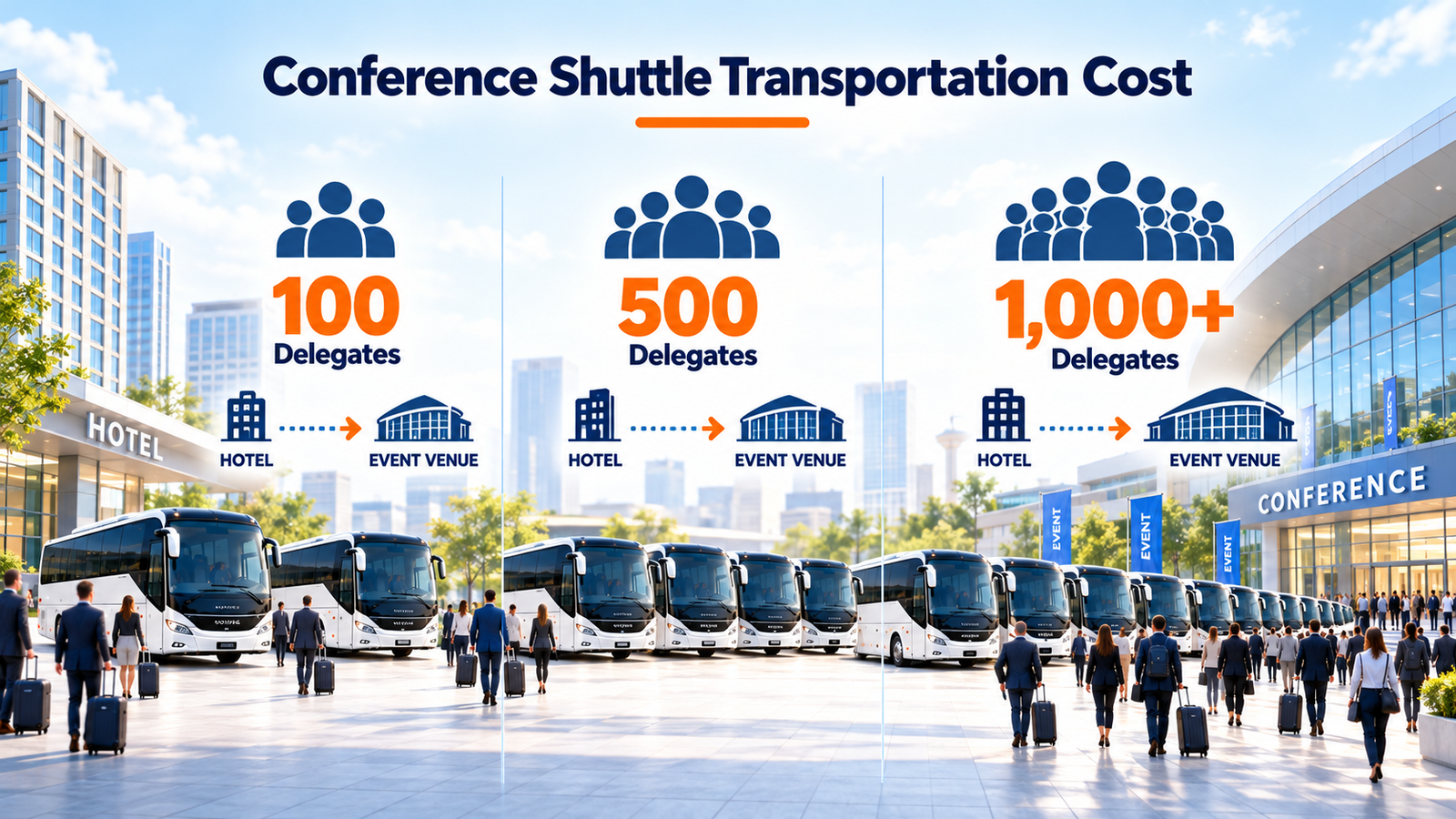
A 1,000-person conference does not automatically require transportation for 1,000 people at the same time.
Some attendees may stay within walking distance. Others may use taxis, rental cars, or public transportation. Even delegates using the official shuttle may travel in different arrival waves.
That is why conference transportation budgets should start with two numbers:
expected shuttle users + passengers moving during the busiest period
Those figures are far more useful than total registrations alone.
Key Takeaway
Conference shuttle transportation cost is driven primarily by peak passenger demand, fleet size, operating hours, route length, hotel locations, and event duration. For early planning, estimate how many registered delegates will actually use the shuttle, then calculate the number that must move during the busiest 30–60 minutes. Staggered departures and repeat loops can significantly reduce the number of coaches required.
How Many Delegates Will Actually Use the Shuttle?
Do not automatically budget transportation for every registered attendee.
For early planning, an event organizer might model 60%–80% shuttle uptake, then replace that assumption with actual hotel and transportation data as registrations develop.
For example:
500 registrations × 70% expected shuttle use = 350 riders
Your final forecast should consider:
- Delegates staying at official hotels
- Local attendees
- Walkable hotels
- Rental cars and taxis
- Speakers and VIP transportation
- Accessibility requirements
Our Corporate Event Transportation Planning Guide recommends planning around individual passenger movements rather than total event attendance.
Conference Shuttle Cost by Delegate Count
For budgeting, this guide uses approximately 50 passengers per full-size coach and a U.S. planning range of 1,400–3,000 per coach per day.
|
Peak Riders |
Coach Loads |
Approx. Daily Budget |
Cost per Rider |
|
100 |
2 |
2,800–6,000 |
28–60 |
|
250 |
5 |
7,000–15,000 |
28–60 |
|
500 |
10 |
14,000–30,000 |
28–60 |
|
1,000 |
20 |
28,000–60,000 |
28–60 |
These are planning estimates, not fixed Global Bus Hire rates.
They also assume every passenger must move in one wave. That is where better scheduling can change the budget dramatically.
Example: 1,000 Delegates Without 20 Coaches
Suppose 1,000 delegates are staying near the venue and the hotel-to-conference journey takes about 15 minutes.
Instead of moving everyone at 8:30 AM, arrivals are divided into three waves:
- 7:30 AM: 400 delegates
- 8:00 AM: 350 delegates
- 8:30 AM: 250 delegates
At approximately 50 passengers per coach, the busiest wave requires around:
400 ÷ 50 = 8 coaches
With suitable turnaround time and nearby hotels, those coaches can be reused for later waves instead of deploying 20 coaches simultaneously.
Illustrative Budget
20 coaches: 28,000–60,000 per day
8 coaches: 11,200–24,000 per day
Potential difference: 16,800–36,000 per day
The actual saving depends on route time, loading time, coach availability, and whether vehicles can complete the required loops before the next departure.
This is why peak demand matters more than total headcount.
Example: 500-Delegate Conference
Consider 500 shuttle users across three hotels:
- Hotel A: 200
- Hotel B: 175
- Hotel C: 125
Assume the hotels are approximately 10–15 minutes from the venue and delegates can arrive across a 90-minute window.
Instead of booking 10 coaches to move everybody simultaneously, a practical starting plan could use 6 coaches running two timed movements.
Estimated Daily Vehicle Budget
6 × 1,400–3,000 = 8,400–18,000
Approximate Cost per Delegate
$8,400 ÷ 500 = $16.80
$18,000 ÷ 500 = $36
So staggered scheduling could reduce the planning cost from 28–60 per delegate to approximately 17–36 per delegate in this example.
Split Shift vs Full-Day Standby
Another major budget question is what happens between the morning and evening peaks.
Suppose coaches operate:
7:00–10:00 AM: hotel to conference
5:00–8:00 PM: conference to hotels
Ask whether the vehicles can be released during the middle of the day or must remain on standby.
A split-shift arrangement may reduce unnecessary vehicle and driver time where local operating arrangements allow it.
Full-day standby may cost more, but it provides flexibility for delegates leaving early, emergency movements, speakers, or schedule changes.
Do not assume both options are priced the same. Ask for each scenario when requesting your charter bus rental quote.
A 7 AM–11 PM Event Needs Driver Planning
Conference schedules can easily create very long transport days.
For example:
First shuttle departure: 7:00 AM
Final gala return: 11:00 PM
That is a 16-hour operating window.
For U.S. passenger-carrying commercial vehicles, FMCSA rules generally prohibit a driver from driving after accumulating 15 hours on duty following eight consecutive hours off duty. Driving itself is limited to 10 hours after the required off-duty period.
A 7 AM–11 PM shuttle operation may therefore require a driver change, second driver, or redesigned schedule.
That additional driver requirement should be included in the transportation budget.
Plan Accessibility Early
For large U.S. conferences, accessibility requirements should be identified during registration rather than shortly before the event.
Ask whether delegates require:
- Wheelchair-accessible vehicles
- Lift or ramp access
- Wheelchair securement
- Additional boarding time
- Accessible loading areas
- Assistance with luggage
The ADA covers transportation services including intercity and charter buses, and businesses must provide people with disabilities equal access to their services.
Sharing these requirements early gives us more time to arrange the appropriate vehicles and loading plan.
What Should Be Included in the Budget?
Your conference transportation budget should consider more than coach count:
- Daily vehicle charges
- Driver costs
- Hotel-to-venue routes
- Operating hours
- Waiting or standby time
- Parking and tolls
- Additional drivers
- Airport transfers
- Off-site dinners
- Accessible transportation
- On-site transport coordinators
- Backup capacity
For detailed pricing factors, see How Much Does It Cost to Rent a Charter Bus? 2026 Pricing Guide.
Get a Conference Shuttle Transportation Quote
Conference transportation should be designed around how delegates actually move, not simply the number printed on the registration dashboard.
Send us your delegate count, expected shuttle users, hotel list, venue, event schedule, arrival windows, accessibility requirements, and off-site movements.
We can then plan the coach fleet around the busiest periods and identify where timed shuttle loops may reduce unnecessary vehicles.
Contact Global Bus Hire to request a customized conference shuttle transportation quote.
Frequently Asked Questions
How many coaches do I need for 500 conference delegates?
If all 500 move at once, approximately 10 coach loads may be required at 50 passengers per coach. With nearby hotels and staggered arrivals, fewer vehicles may complete multiple loops.
How many buses are needed for a 1,000-person conference?
Moving 1,000 people simultaneously could require around 20 coach loads. In the example above, dividing attendees into waves reduced the peak requirement to approximately eight coaches.
What percentage of conference delegates use event shuttles?
There is no universal percentage. For initial budgeting, organizers can model scenarios such as 60%, 70%, and 80% uptake, then refine the number using hotel bookings, registration surveys, and local attendee data.
How much should I budget per delegate for conference transportation?
It depends on shuttle uptake and scheduling. In the examples above, simultaneous movement produced a planning range of roughly 28–60 per rider per day, while staggered loops reduced the 500-delegate example to approximately 17–36.
Is it cheaper to keep coaches all day or use split shifts?
It depends on local pricing, driver scheduling, and how much transportation is needed between the morning and evening peaks. Request both options if delegates do not need continuous daytime transportation.
Do conferences need wheelchair-accessible shuttle buses?
Accessibility requirements should be identified early and appropriate transportation arranged for delegates who need it. For U.S. events, relevant ADA requirements should be considered as part of the transportation plan.
When should conference transportation be booked?
Large conferences requiring several coaches should be planned well in advance, especially during convention periods, major citywide events, and peak travel seasons.
